Nebraska Midterm Results Defy Red Narrative
County-level data shows a shift toward Democrats across the state, contradicting the governor's recent claims of a Republican surge.
By Ryan Davidson ·
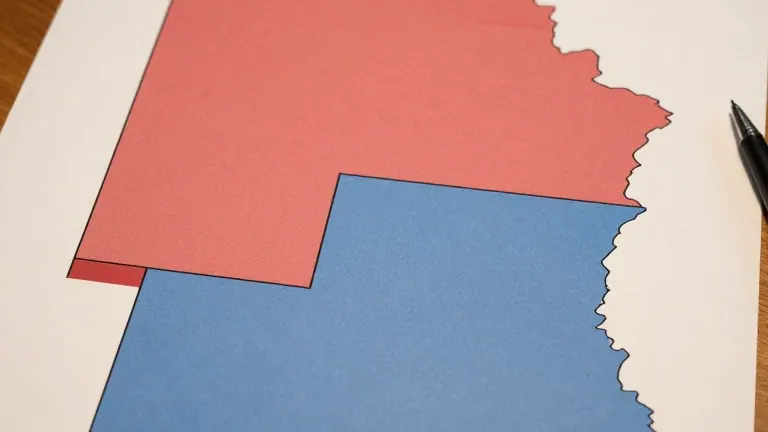
For Nebraskans, the visual narrative of their state’s midterm results contradicts the political reality on the ground. Governor Jim Pillen recently presented a map depicting Nebraska as a red outlier in a national blue wave. That image, shared by the Ground News organization, relies on geographic size rather than voter counts. The large red area corresponds to the 3rd Congressional District, a region that is roughly 57 times larger in land mass than the state’s smallest district.
The discrepancy between land area and population skews the visual interpretation. When looking at the actual number of voters, the picture changes. More than 767,000 ballots were cast in Tuesday’s election. This figure is approximately 198,000 lower than the total cast in the 2024 presidential race. It is also about 10,000 fewer than the ballots counted in the 2020 election. Lower turnout often complicates the analysis of political trends, but the direction of the vote is clear in the county-level data.
The Associated Press analyzed the shift in voting patterns by comparing the 2026 midterm results to the 2024 presidential vote. Their review indicates that every county in Nebraska shifted toward the Democratic column. This uniform movement across all counties suggests a broad change in voter preference that is not visible on a simple red-and-blue map. The data points to a narrowing of the margin for Republican candidates rather than an expansion of their base.
In the race for governor, the numbers reflect this decline in support for the Republican ticket. The margin for victory in 2026 sits nearly as low as the smallest Republican margin since 1996. A similar trend appears in the Senate contest. The gap between the two candidates represents the lowest margin for a Republican winner in that seat since the mid-1990s. These narrow victories contrast with the sweeping impression given by the geographic map.
The Senate race added another layer of complexity for voters. The ballot featured Republican Senator Pete Ricketts and independent candidate Dan Osborn. Many observers labeled Osborn a Democrat, but no Democratic candidate appeared on the final ballot. Cindy Burbank, who won the May primary, withdrew her name from the general election race. This absence of a third major party option meant the contest was effectively a two-way race, though the independent status of one candidate altered the dynamics for voters.
Governor Pillen’s team did not immediately provide a specific source for the map used in the Friday news conference. The visual aid highlighted the 3rd Congressional District, represented by Adrian Smith. Smith won his seat by nine fewer points in 2026 than he did in 2024. The decline in his personal margin aligns with the statewide trend of a shrinking Republican advantage, challenging the narrative of a red wave in Nebraska.