
Democrats Target Trump Family and DHS in New Oversight Push
Incoming committee chairs plan aggressive subpoenas for business deals and agency actions, while the president signals a reliance on his veto power.
By Nour Haddad ·
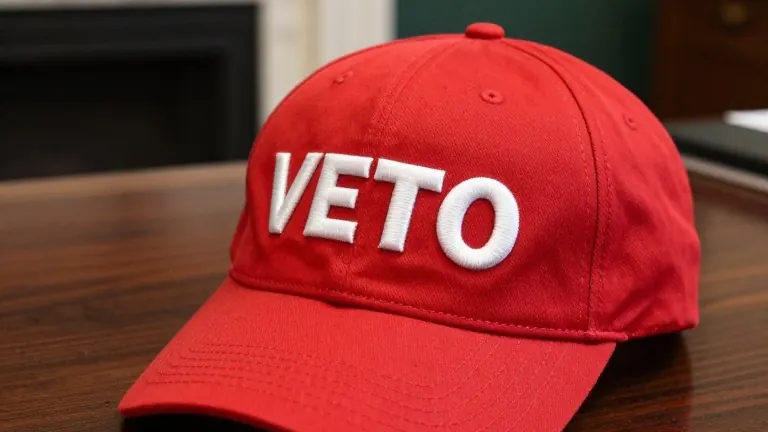
President Trump placed a red hat labeled VETO on the Resolute Desk in the Oval Office on Thursday, signaling his intent to use the presidential veto as a primary tool against the incoming Democratic Congress. The move followed a series of mixed messages from the White House regarding the new balance of power. Early Tuesday night, Trump told Politico he intended to cooperate with Democrats. By Wednesday, he had refined that stance, telling reporters at a White House construction site that he would likely work with the new leadership unless they acted destructively.
The incoming House Democratic leadership has already mapped out a financial agenda. Rep. Robert Garcia of California, who will lead the Oversight and Government Reform Committee, identified the Trump family’s business dealings as a top target. Garcia specified an interest in a $2 billion investment from Saudi Arabia, Pentagon contracts linked to the president’s sons, and potential kickbacks related to Department of Homeland Security contracts and White House ballroom donations. He also listed the Jeffrey Epstein scandal and corporate corruption for scrutiny.
Garcia warned administration officials to prepare for testimony, naming White House deputy chief of staff Stephen Miller, former DHS officials Corey Lewandowski and Kristi Noem, and members of the Trump family. He noted that Democrats can utilize civil contempt processes through the courts if the Justice Department fails to enforce compliance. Rep. Jamie Raskin of Maryland, who will head the Judiciary Committee, plans to examine the Justice Department’s handling of the Epstein case and what Democrats call slush funds, including the Board of Peace initiative and anti-weaponization funds.
Rep. Adam Smith of Washington, the top Democrat on the Armed Services Committee, intends to investigate the war against Iran, sweetheart deals in government contracts, and unauthorized military strikes in the Caribbean and Latin America. Rep. Rosa DeLauro of Connecticut, expected to lead the Appropriations Committee, plans to use budgetary tools to address cost-of-living issues. She stated she would fight the administration to hold it accountable for corruption, potentially using guardrails in appropriation bills.
The shift in power dynamics complicates the president's ability to confirm nominees. Democratic control of the Senate will make confirmations more difficult, leading Trump to consider acting officials or candidates with bipartisan appeal. He indicated that confirming a new Defense Secretary before the new Congress is seated would be easier than after. Brandon Rottinghaus of the University of Houston described the final two years as the hardest of Trump’s political career, noting that his leverage over Republicans will diminish.
Impeachment remains a lower priority for the new caucus. House Minority Leader Hakeem Jeffries stated that no members of the Democratic Caucus have discussed the move with him. Rep.-elect Melat Kiros of Colorado and Rep.-elect Chris Rabb of Pennsylvania expressed skepticism about the likelihood of removal. Trump himself dismissed the threat, stating that impeachment for no reason would destroy the Democratic Party.
The new Congress is scheduled to convene in January. Until then, the White House is proceeding with executive actions, including a recent order designating the Oval Office and Cabinet Room as national landmarks to restrict future changes.
More Business · National news · Business Watchdog · Report a business · Got a Story?