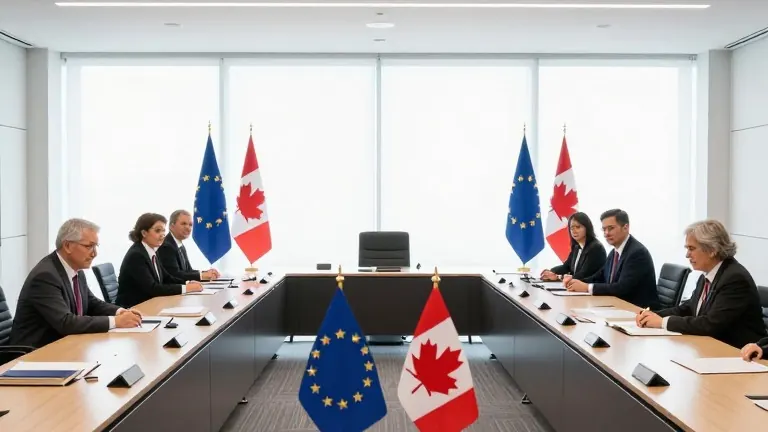
Canada and EU Shift to Vague Language as 'Associate Member' Label Vanishes
The 21st summit in Montreal will feature a draft statement promising closer ties, but the specific status Canada sought was removed due to internal opposition.
By Stella Brooks ·

The specific label that would have designated Canada as the European Union’s first associate member has been removed from the draft joint statement for the upcoming summit in Montreal. The change, confirmed by sources on Wednesday, replaces the term with a broader call for an "ever-closer association." This shift leaves the precise legal and political status of the new relationship undefined until the final document is released on Friday.
European Commission President Ursula von der Leyen announced in September that the EU would begin a process to grant Canada associate membership. However, several EU nations opposed the specific tag. A senior EU official stated on Tuesday that all 27 member states agreed on the goal of the "closest possible association" with Ottawa, even as the terminology in the draft document evolved.
Prime Minister Mark Carney had previously suggested different phrasing, such as "an alliance for the future." Sources indicated that the current draft is still subject to change before the summit concludes. The statement is expected to promise tighter integration, though experts note that the exact mechanics of this "ever-closer" bond remain unclear.
The complexity arises because Canada does not fit into existing EU partnership models. The Schengen Area, which includes 25 of the 27 EU countries plus Norway, Switzerland, Iceland, and Liechtenstein, facilitates border-free travel. Within that framework, the European Free Trade Association (EFTA) allows those four non-EU nations to maintain economic ties without surrendering autonomy or gaining decision-making power within the EU institutions.
Other models, such as the EU Customs Union, include Monaco, Andorra, Turkey, and San Marino. This arrangement removes internal tariffs and applies a common external tariff, but it grants less individual freedom than the EFTA model. Florian Gassner, a professor of Central, Eastern, and Northern European studies at the University of British Columbia, argued that none of these options suit Canada.
"To put it in one phrase, the Canadian economy is too large and integrated into global markets to be rebuilt in the short term to fit into these existing agreements," Gassner said. A senior Canadian official previously told CBC News that a deep analysis of these relationships concluded they would not work because Ottawa does not want to trade independence for access.
Gassner noted that Canada is likely seeking privileged market access without amending its own constitution. He described the negotiation dynamic as a "fundamental push and pull" between gaining enfranchisement and accepting regulation. He pointed to Romania, which had to restructure its farming practices to comply with EU rules, and Bulgaria, which saw European corporations purchase coastal property on the Black Sea.
Canada’s caution is also evident in its approach to labor mobility and trade protections. While student exchange and worker mobility are part of the discussions, Gassner said Ottawa is wary of opening borders too widely. He highlighted the risk of the Canadian market being flooded with highly subsidized European dairy products, stating, "Probably that is what Canada is primarily defending against, not to have the market flooded with cheap, subsidized European goods."
Nelson Wiseman, a political science professor emeritus at the University of Toronto, said the partnership will likely cover defense and trade. He noted that full EU membership would require the bloc to negotiate with the United States on Canada’s behalf, a dynamic that does not align with current Canadian policy. "All they know is there are good feelings between them," Wiseman said. "They both want to diversify away from the U.S. They both don’t want to come under China’s thumb."
The 21st Canada-EU summit is scheduled for Friday in Montreal. The final joint statement will define the next steps in a relationship that experts describe as unique, balancing the desire for deeper cooperation with the need to retain national sovereignty.