
India's $22 Billion Defense Push: New Weapons to Counter China
The government approved 2.12 trillion rupees for drones, air defense systems, and naval platforms following confirmed border skirmishes.
By Aaron Foster ·
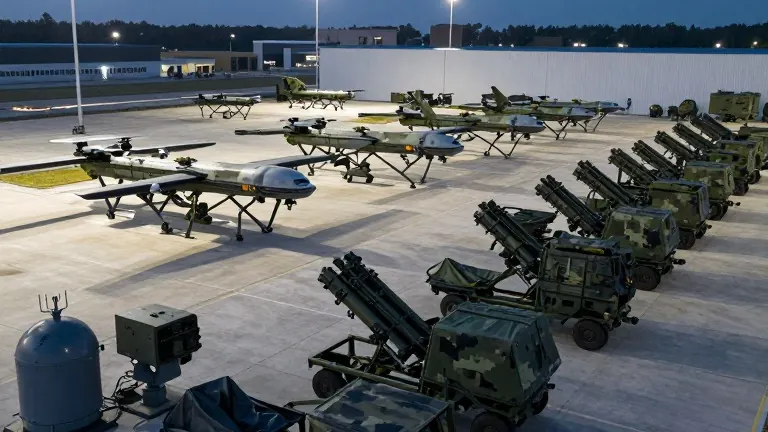
India approved a 2.12 trillion rupee ($22 billion) spending package on Monday to modernize its military hardware. The funds are earmarked for long-range kamikaze drones, surveillance and strike systems, counter-drone technologies, short-range air defense, artillery, helicopters, and naval platforms. The announcement comes as New Delhi seeks to close the technological gap with its northern neighbor, China.
The spending follows a period of heightened tension along the border. Last week, an Indian military official confirmed that confrontations with Chinese soldiers were ongoing across several locations in the north-eastern border region. Shatrujeet Singh Kapoor, director general of the Indo-Tibetan Border Police, described China as the biggest adversary. He argued that competing with China using traditional methods would become increasingly difficult.
India is the world's fifth-largest military spender, allocating $92 billion annually to its defense budget. However, that amount is less than 30% of China's military expenditure and roughly one-tenth of what the United States spends. Pieter Wezeman, a senior researcher at the Stockholm International Peace Research Institute (SIPRI), noted that New Delhi increasingly views Beijing as a primary threat. This perception is reinforced by strong military ties between China and Pakistan, another of India's nuclear-armed neighbors.
A SIPRI report from earlier this year found that 61% of Chinese arms exports between 2021 and 2025 went to Pakistan. In response, India is diversifying its supply chain. Wezeman stated that the latest purchases will involve importing artillery components and technology from South Korea, engines and avionics from France, and drones from the United States and Israel. Collaboration with Russia and Japan is also possible given India's need for technological upgrades.
The government aims to procure 82% of this new equipment from local industries. Nevertheless, foreign partners will play a key role in providing critical technology. Arpit Chaturvedi, South Asia advisor at strategic advisory firm Teneo, explained that India still relies on imported technologies for specialized components such as aircraft engines, propulsion systems, sensors, and electronic subsystems. He predicted that American, Israeli, and Russian defense manufacturers will find substantial opportunities in India's expanding market through joint ventures and co-production agreements.
This $22 billion package is part of a larger surge in defense spending. Since April, India has greenlighted military spending totaling 3.7 trillion rupees. According to a Citi report released on Tuesday, this figure represents more than 50% of the 6.73 trillion rupee worth of approvals in the financial year ended March 2026. That total marks a 10-year high for annual defense procurement.
India remains a major player in the global arms market. It was the world's second-largest importer of major arms between 2021 and 2025, accounting for 8.2% of total global imports. While its reliance on overseas suppliers dropped by 4% during that period due to growing local design capabilities, the country still imports significant technology. Collin Koh Swee Lean, a senior fellow at Singapore's Nanyang Technological University, observed that conflicts in the Middle East and Ukraine have demonstrated that mass-produced systems like drones can help address military asymmetry.
Diplomatic exchanges have remained tense. A spokesperson for India's foreign ministry said on Friday that the situation in the border areas gets disturbed from time to time when Chinese forces diverge from established patrolling patterns. Beijing responded by stating that it strictly abides by the relevant agreements and common understandings reached between the two countries.